
The classic approach: Quality Trees
A quality tree (syn: quality attribute utility tree) is a hierarchical model to describe product quality: The root “quality” is hierarchically refined into areas or topics, which themselves are refined again. Quality scenarios form the leaves of such a tree.
- Standards for product quality, like ISO 25010, propose generic quality trees. You find this generic quality tree in question C-1-2 (quality goals).
- The quality of a specific system can be described by a specific quality tree (see the example below).
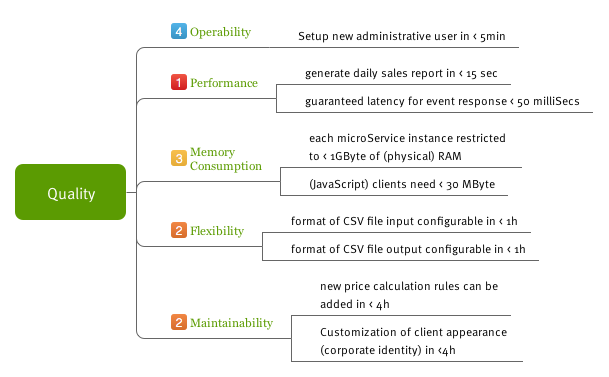
While quality trees provide a visual overview, they have practical limitations: The strict hierarchy forces quality properties into a single branch, even though many properties (e.g. “response time”) could belong to multiple categories. Maintaining such trees becomes cumbersome as the number of quality requirements grows.
The modern approach: Tagging and labelling with Q42
The Q42 approach replaces the rigid tree hierarchy with a flexible tagging and labelling system. Instead of forcing quality properties into a single branch of a tree, each quality requirement can be tagged with multiple quality attributes (e.g. a scenario might be tagged with both performance and usability). This makes organising, filtering, and searching quality requirements far more practical, especially in larger systems.
What really matters: Quality Scenarios
Regardless of whether you use a classic quality tree or the modern Q42 tagging approach, the detailed quality scenarios are the most important part of your quality requirements. A quality scenario describes a concrete, measurable situation: a stimulus arriving at the system under specific conditions, and the expected response or behavior. These scenarios make quality requirements testable and verifiable — they are what drives architectural decisions, not the categories or tags above them.
Focus your effort on writing precise, specific quality scenarios rather than debating the perfect hierarchy or tagging scheme. See question C-10-2 (quality scenarios) for details on how to write and use quality scenarios.
See also
- Q42 — quality.arc42.org — modern tagging-based approach to organising quality requirements
- ISO 25010:2023 — the current ISO standard for systems and software quality models